When Knowing Your Audience Isn’t Enough: What Happened to Orkut?
Imagine having a social network that dominates a market for years, attracts millions of users, and creates more than a million communities—only to eventually disappear.
That is basically the story of Orkut.
Google launched Orkut in 2004. Although it never became the dominant social network in the United States, it found an incredibly strong audience in Brazil. According to our case study, 90% of Orkut’s page views came from Brazilian users, and the platform eventually reached 30 million users at its peak (Mahoney & Tang, 2017).
Orkut clearly understood something about its audience. The problem was continuing to evolve with them.
Building a Community Instead of Just an Audience
One of Orkut’s biggest strengths was its focus on communities.
Users could search for groups based on their interests and connect through schools, workplaces, neighborhoods, and other shared experiences. Just four months after Orkut launched, users had created more than 50,000 communities. Within a year, that number had grown to approximately 1.5 million (Mahoney & Tang, 2017).
I think there is an important difference here for marketers. Having an audience means people see your content. Having a community means people have a reason to participate.
That idea is still relevant today. Modern brand communities focus on creating spaces where customers can interact with both the brand and each other rather than simply receiving advertisements.
Why Brand Communities Matter — Sprout Social
Why Did Brazil Love Orkut?
Orkut’s success in Brazil also demonstrates how closely culture and social media behavior are connected.
Brazilian consumers had a strong interest in digital and social media, and the community-focused design of Orkut fit naturally with how people wanted to connect online. Google later described Orkut as being at its peak in Brazil during the company’s early years in the country and noted that Brazilian users represented a substantial portion of its audience.
This is something marketers cannot ignore. A strategy that connects with one audience or culture may not work exactly the same somewhere else. Brands need to understand how their audiences communicate, what influences them, and what they expect from their digital experiences.

So, What Went Wrong?
This is where I think the Orkut story becomes especially useful for today’s marketers.
Understanding your audience once isn’t enough.
Brazilian consumers increasingly wanted experiences involving video and multiple digital platforms. Meanwhile, Orkut experienced functionality problems involving limitations on friends and difficulties loading and sharing photographs (Mahoney & Tang, 2017).
Eventually, other platforms were better positioned to provide the experiences users wanted. Google announced in 2014 that Orkut would shut down and explained that communities on platforms such as YouTube, Blogger, and Google+ had grown faster than Orkut’s community.
Google’s Original Announcement About Closing Orkut
Orkut’s initial success proves that it understood its audience, but its decline shows why ongoing monitoring and evaluation are so important. Consumer expectations don’t remain frozen just because a strategy was successful in the past.
What Can Brands Learn From Orkut?
If I were advising a brand based on this case, I would focus on three things:
- Listen continuously. Audience research shouldn’t stop after a strategy launches.
- Build communities, not just follower counts. Give people opportunities to participate and connect.
- Adapt before you have to. Technology and consumer expectations can quickly change what people consider a good digital experience.
This lesson may be even more relevant today. Current social media research emphasizes that brands need to remain active within their communities, understand how people interact across different networks, and adjust as platforms and audience expectations change.
Orkut became incredibly successful because its technology fit the culture and behaviors of its audience. However, when those behaviors evolved, the platform struggled to evolve with them.
Getting your audience’s attention is only the beginning. Keeping it requires understanding how their needs continue to change.
Featured image
I think the best choice is an actual screenshot of the old Orkut interface. It immediately shows readers what the platform looked like and gives your post some nostalgia/history.
Under the image in WordPress, add a caption/credit such as:
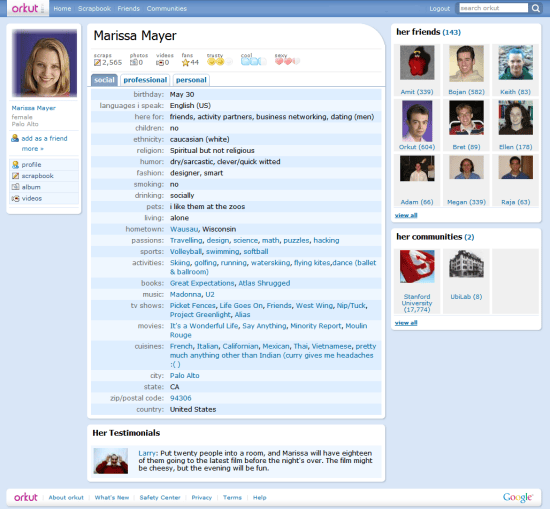
Since it’s a curated image rather than your own, including that credit helps satisfy the rubric’s copyright requirement.
Socials:
- X : @Abeltr2026
- Linkedin : www.linkedin.com/in/ alejandro-beltran-7b53b0421
 Cafe Ositio
Leave a comment